Educational Project for Most Deprived Children
Our educational project is being run chiefly for the children of the most deprived castes and classes. We could of course have reserved the school exclusively for Dalit children. But we considered it healthier for them to grow up with children of all castes. We were conscious, however, that Dalit children must have a psychological advantage in their interactions with upper-caste children. So we reserved half the seats for them. Such a setting, we felt, might be good for upper-caste children too – they would learn to respect Dalits. On the same reasoning, we decided to reserve slightly more than half of the seats for girls.
Our educational project is run in three parts:
- a non-formal, innovative Primary School (including a school readiness programme);
- a formal yet innovative Middle School (classes 6 to 8); and
- a vocational High School.
The school is called Krishi Audyogik Vidyalaya. The National Institute of Open Schooling (NIOS) has accorded accreditation to our High School as a Vocational Institution. Presently the total number of children in our school is 331. Our students are typically first generation students. No fee is charged.
The Primary School includes school readiness (or class 0), and classes 1 to 5. The school readiness programme is for 3 or 4-year olds, who are not yet ready for school. They spend half the day in school and are sent back after taking their mid-day meals. The main objective of this programme is to help children feel secure even outside the home environment and help them with verbal skills and pre-number concepts.
In the Primary School proper we devote half the time to academics and half to self-expression activities, which include music, games, computers, and creative activities like handling meccanoes, builder blocks, etc. The children also participate in distributing mid-day meals to themselves. The general atmosphere in the primary section is that of fun, play, and joy. Little children are here being helped to grow and are being prepared for entry into the formal system of education.


In the Middle School, we teach academics and agriculture, and we teach computers and trades (sheet metal work and typing for boys, and tailoring for girls).
Though there is still fun and play and joy in the formal Middle School, yet this is no longer the dominant note. There is on the contrary an undercurrent of greater seriousness. Here too the children are being helped to grow, but a more earnest aim has come into existence: the children are now being readied for life itself. The children still play of course, and they go out on study excursions, conduct the numerous functions held in the school, keenly enjoy themselves and always remain comfortable in the school. Yet the more serious object is not forgotten. The children know they have to study and appear in regular quarterly examinations; they know they have to learn various skills as part of their preparation for a future life.
Our High School encourages girls. This prevents their dropping out after middle school under parental pressure. At present more than half the students in our School are girls. The education being thus received by Dalits and by girls constitutes a silent revolution in rural society.
Our students long to escape from the tyranny of poverty. They seek something utterly practical. Our response has been two-fold:
- helping them to acquire certain vocational skills, and
- constantly improving the teaching-learning process in academics.
As to (A), we teach the following vocations in the accredited Vocational Institution attached to our High School:
- For Girls exclusively: (i) Tailoring, and (ii) Beauty Culture. The latter may seem surprising in a village context. But in fact all village brides need to be decked, and beauty culture is much in demand. Naturally, what our girls learn does not conform to rigorous urban standards.
- For boys exclusively: (i) Repair of radio, TV, stabiliser, and DVD player; and (ii) Electrical Technician with emphasis on transformer and motor rewinding.
- For all students: Data Entry Operations (Word, Excel, Power Point), and introduction to internet and email.
- Agriculture-related: (i) (a) composting of biodegradable organic matter by employing a certain species of earthworm (Vermicomposting), (b) aerobic composting of farm waste (Nadep), and (ii) production of button Mushroom. Our staff underwent training in the Allahabad Agricultural Institute (now Sam Higginbotham Institute of Agriculture, Technology and Sciences or SHIATS). Vermi-compost, Nadep compost, and button mushrooms are being produced in the school in substantial quantities.
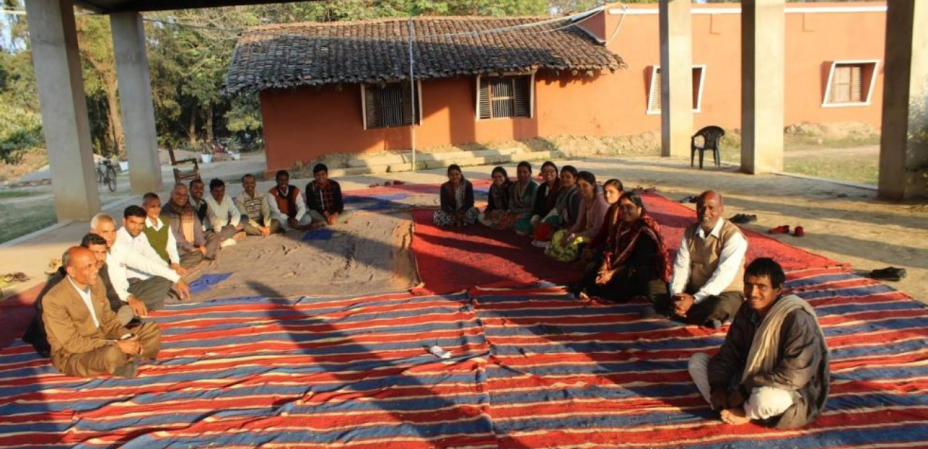
As to (B), first generation students usually find academics extremely difficult. The role played by the teacher is therefore vital for them. But being local Banda people, the teachers themselves need to be motivated and encouraged. We therefore run a Teacher Development Programme which clarifies the academic content of each subject, helps improve their teaching skills, and seeks to renew their motivation.
But teachers need financial security. They deserve satisfactory salaries. And this is the central problem facing us today.
On the other hand, a new element has been introduced in the field of education by the government. Its unintended consequence has been to de-stabilise non-governmental efforts. I refer to the Right to Education Act and the dramatic increase in the number of government primary schools. A huge demand has suddenly been created for primary school teachers. Since government teachers receive much higher salaries, every teacher from every non-government school (whether he teaches in a High School or Middle School or Primary School) is now seeking entry into the expanding government structure at the primary school level.
Consequently, better quality teachers are beginning to shift to the government sector which is dysfunctional, which will not easily or quickly improve, and where performance is irrelevant. But quality schools like ours (where performance is the most important thing) are being deprived of good teachers. This is the tragedy of our country.
Unless we can provide better salaries, the turnover of teaching staff in our school will increase. This is not desirable in an educational institution. Children require stability in their relationships. This gives them security and enables them to draw on the steadying influence of familiar persons. But if teachers are changing, the children suffer; and the teaching suffers too.
This is the current situation in our work.
 Bhoomiheen Seva Samiti